Four Men's Facial Cleanser Types, From Soap-Based to Amino Acid
Men's cleansers are specified by type first and texture second, and the type decides almost everything downstream: how the skin feels after rinsing, which claims you can make, and how long the formula takes to settle. Four types cover most briefs — soap-based, amino acid, compound and exfoliating — and each one carries a different cost in development time. A launch twelve weeks away rules out some of them before the first sample is made.
Key takeaways
- Soap-based formulas clean hard and feel tight; amino acid systems rinse milder and suit daily use.
- Compound cleansers combine both bases, which is why they dominate mid-market men's ranges.
- Exfoliating cleansers add a second mechanism and therefore a second test: particle size or acid level both change the stability plan.
- Route matters more than type on tight deadlines: an existing base runs 4–8 weeks, a new development 3–6 months.
The four types, and who each one suits
Soap-based formulas are the traditional choice for oily skin and heavy cleansing. They are cheap to produce, they rinse clean, and they are unforgiving on dry or reactive skin because the after-feel is tight. A brief that targets sport or heat will usually open with this type.
Amino acid surfactants sit at the other end. They foam less aggressively, rinse without the tight feeling, and tolerate daily use, which is why premium men's ranges often lead with them. Compound cleansers mix the two bases so the formula can clean like a soap while finishing milder; that middle ground is where most volume sits. Exfoliating cleansers add physical or chemical action, and the added mechanism is the part that needs testing.
pH and after-feel carry the brief
Skin feel after rinsing is a pH story as much as a surfactant story. Buyers describing "fresh but not stripped" are asking for a milder system; buyers describing "squeaky clean" are asking for a soap base. Put that sentence in the brief, because a supplier will translate it into a base and a pH target rather than a marketing line.
Once the type is fixed, texture follows. The published range breaks textures into cream, creamy, gel, foamy and powdered cleansers, and each one changes the filling line and the pack format. A gel dosed from a pump and a cream squeezed from a tube can share a base and still feel nothing alike.
Timeline: what the route costs before the first batch
Two schedules dominate every men's cleanser project. Using an existing formula, the published route runs four to eight weeks. Building a new development — research, testing and production treated as one block — runs three to six months. The difference is not packaging or filling; it is the formula work in front of them.
| Route | Published duration | What it covers |
|---|---|---|
| Existing formula, adjusted | 4–8 weeks | Base selection, sampling, filling, delivery |
| New development | 3–6 months | Production included in the development block |
| Stability and compatibility reports | 3–6 months | Runs alongside packaging work, not after it |
| Typical order minimum | 1,000–5,000 units per product | Sets the first batch size and the filling slot |
Format and filling: the hidden link between texture and cost
Texture is a filling decision as much as a skin-feel decision. A gel pours, a cream is dosed by weight, and a powdered cleanser cannot use the same line at all. When a range carries two or three textures, ask early whether they can be filled in the same visit or whether each needs its own slot on the calendar.
Fill weight also moves with texture, because a foaming formula is usually dosed smaller than a cream for the same wash. Specify the millilitres or grams you want on pack, then let the supplier confirm the line can hold that tolerance across a batch rather than just for the first hundred units.
Packaging lead time sits beside all of this and is one of the three factors the supplier names as a schedule risk, together with ingredient sourcing and stability testing. Ordering the pack before the base is fixed is the most common way a men's cleanser launch loses a month.
Worked example: does an OEM route fit a twelve-week launch?
Say your retail window is twelve weeks out, which is 84 days. The existing-formula route takes 4–8 weeks, or 28–56 days, leaving 84 − 56 = 28 days to spare at the slow end and 84 − 28 = 56 days at the fast end. The new-development route starts at three months, which is about 90 days, so 90 − 84 = 6 days short of your window before any delay — and at the six-month end it is 180 − 84 = 96 days past it.
That single subtraction tells you the type question is secondary. If the deadline is fixed, choose from the bases that already exist, adjust the fragrance and the texture, and put the new surfactant system in the second product rather than the first.
Reading the route chart
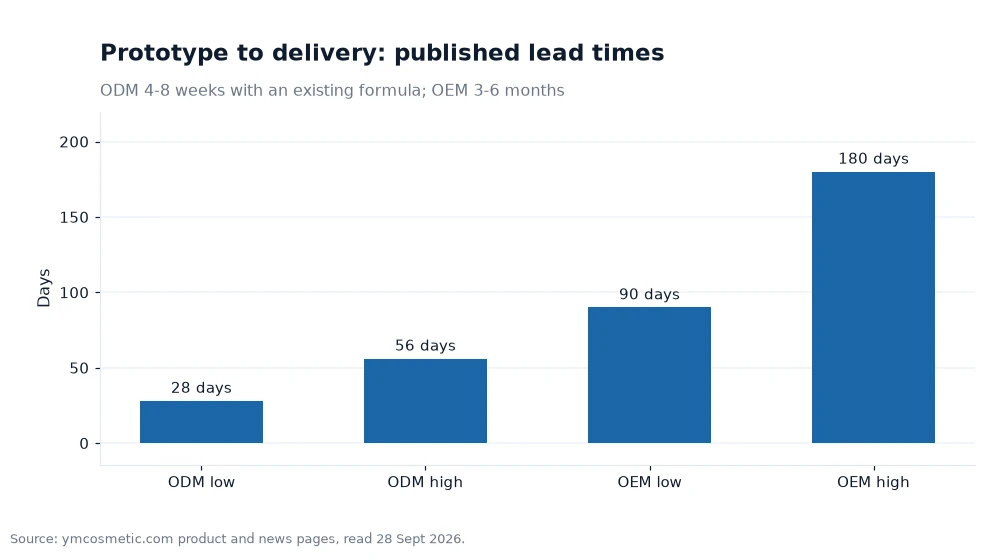
The four bars make the decision look like a step rather than a slope. Between the fastest existing-formula route and the slowest new-development route the gap is 180 ÷ 28, more than six times. In practice a men's cleanser brief rarely needs that gap: the surfactant families are well documented, so most launches are adjustments on a known base rather than a new system.
Frequently asked questions
Which type should a first men's cleanser use?
Pick by skin target rather than trend. Oily or sport-focused ranges suit a soap-based or compound base, daily-use ranges suit amino acid systems, and an exfoliating variant is best treated as a second product in the same range, where its extra testing does not delay the hero item.
Do all four types need the same testing?
No. Base type affects compatibility work, and an exfoliating formula adds its own stability questions because the extra mechanism has to remain stable and uniform across the batch. Planning that extra work is what keeps the range launch in one window.
How many textures can one base support?
The published range lists five texture formats — cream, creamy, gel, foamy and powdered — and one base can often be finished in more than one of them. Texture changes the pack and the filling line, so decide it before the pack artwork is signed off.
Deciding the type in one meeting
Write three sentences: who the product is for, how the skin should feel a minute after rinsing, and when it must be on shelf. Those three answers select the type, the texture and the route, in that order. Yunmei's own page on the men's facial cleanser range lists the four types and five textures as the starting points, and the OEM/ODM cosmetic manufacturing overview explains how a sample moves from base selection to a filled pack. If the same range needs a lip product, the lipstick development page shows how differently a colour product is specified.
Ymcosmetic.com is where the cleanser types, texture formats and development windows quoted in this piece come from; I read its product and service pages on 28 Sept 2026. The twelve-week arithmetic is mine, built on those durations.[1].