Planning Notes for pre-production and during-production checks
Pre-production and during-production checks are most useful when tied to a current specification, a defined lot or process, measurable criteria, and a clear response to findings. Buyers should confirm readiness before release, review early output, contain deviations with traceability, and keep shipment approval with a named owner.
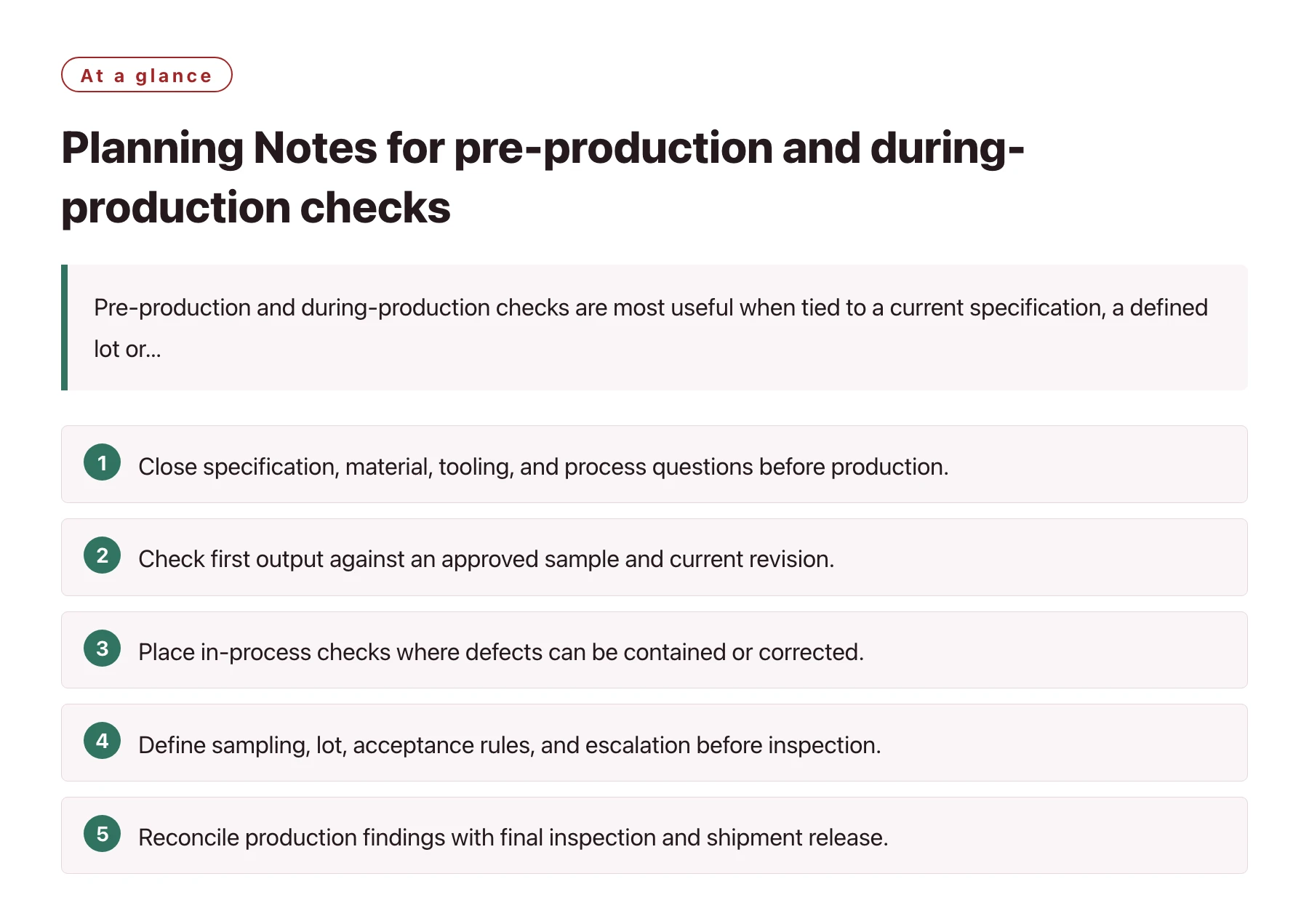
Key takeaways
- Close specification, material, tooling, and process questions before production.
- Check first output against an approved sample and current revision.
- Place in-process checks where defects can be contained or corrected.
- Define sampling, lot, acceptance rules, and escalation before inspection.
- Reconcile production findings with final inspection and shipment release.
A final check may come too late to correct a process problem efficiently. Planned checkpoints expose issues while material, tooling, and production records can still be traced.
Prepare controls before production starts
Pre-production checks should close questions that are expensive to discover after materials or tooling are committed. Confirm the approved specification revision, bill of materials, drawings, packaging, labels, process sequence, and acceptance criteria. Identify which characteristics are critical and who may approve a deviation.
Review the supplier’s readiness evidence: material availability, incoming inspection, equipment and tooling status, operator instructions, test methods, and subcontractor approvals. Tie each record to the specific product, site, and order. A general capability statement does not prove that this order is ready to run.
Use a pre-production meeting to confirm order quantity, timeline, first article or sample, inspection hold points, change notification, document format, and escalation contacts. Record open items and prevent production release if a critical requirement has no owner or decision path.
Verify materials and the first production output
When materials arrive, compare identity, grade, dimensions, color, supplier, and lot records with the approved bill of materials. Check certificates or test documents required by the purchase specification and confirm that they refer to the delivered material. Segregate uncertain or nonconforming lots until the quality owner decides how to proceed.
Review first production output against the approved sample, drawing, and functional requirements. Check the setup, critical dimensions, finish, assembly, labels, and packaging where relevant. Record machine settings or process conditions when they affect conformity, and confirm that the operator is using the current work instruction.
If tooling, material, software, process, or subcontractor changes, require a change notice before the affected work continues. Identify whether the buyer needs a new sample, test, or approval. Keep the old and new revision traceable so goods made under different conditions do not become mixed without review.
Use during-production checks at meaningful points
Select checkpoints based on when a defect can still be contained or corrected. Examples include an early production run, a process that cannot be fully inspected later, a critical assembly, a finishing operation, or a packaging step. The purpose is to see whether the agreed method is being followed and whether actual output meets stated criteria.
Define the sample basis and method before the visit. ISO 2859-1:2026 provides sampling schemes indexed by acceptance quality limit for lot-by-lot inspection by attributes. A quality owner should select the applicable plan and edition, define the lot, sample selection, acceptance rules, and response; an AQL value alone is not a complete inspection instruction.[1]
Ask for records that connect the sample to the order, lot, line, date, and operation. Report observed quantities, measurements, defects, photos, limitations, and any corrective action. A check during production describes the sample and process at that time; it does not establish that all later units conform.
Respond to findings without losing traceability
For a deviation, identify affected items and contain them before further processing or packing. Record the requirement, evidence, quantity or scope, immediate action, root-cause owner, and proposed correction. The buyer’s authorized quality or technical owner should decide whether to rework, sort, replace, retest, accept under concession, or reject.
Check that a correction addresses the cause and confirm it on subsequent output. If a problem may affect earlier production, determine which lots and shipments need review. Update the plan when an issue changes risk, and make sure the supplier distributes revised instructions to all relevant lines and subcontractors.
Keep samples, reports, supplier responses, approvals, and lot records connected to the purchase order. If a finding is unresolved at the next inspection, list it again with its status and impact. Do not close it only because the original observer has left the site.
Coordinate production monitoring with final release
During-production checks complement final inspection, document review, and any required testing. Define what each stage covers and avoid duplicating a check while leaving another requirement unverified. If production output or packaging changes after an inspection, determine whether the earlier evidence remains valid.
Set a release checklist with completion status for production quantity, critical defects, open corrective actions, labels, packaging, documents, and shipment count. Identify the person with release authority. A schedule update or inspection report should not automatically authorize shipment unless the buyer’s rules say so.
For product quality checks in China, buyers can specify pre-production review, in-process checkpoints, sampling method, reporting, and escalation. Define the supplier site and process, assign independent technical decisions to qualified owners, and keep final order release with the named buyer representative.
Sources
Frequently asked questions
What should be completed before a supplier starts production?
Confirm specification revision, materials, tooling, work instructions, acceptance criteria, sample status, inspection points, change control, and owners for open decisions.
Does an in-process inspection replace final inspection?
No. It checks selected output and process conditions at a point in production. Define how it complements final checks, document review, and any required testing.
Is an AQL value enough to tell an inspector what to do?
No. Specify the sampling standard and edition, lot, selection method, inspection level, sample size, acceptance rules, criteria, and actions after a finding.
Who can release goods after a production finding?
The buyer’s named authorized quality or technical owner should review evidence, disposition, open actions, and shipment conditions before release.