Before You Sign for Solid or Oil Fragrance: Twelve Questions for a First Contract
Most first fragrance contracts are signed at the point of maximum optimism and minimum information. The supplier has produced a good sample, the founder wants to move, and the agreement is treated as a formality. In solid and oil formats that is a costly sequence, because the base is a second piece of intellectual property, the product can fail in storage rather than in the hand, and the approved sample has to remain reproducible months later. Twelve questions will surface nearly every term a first contract needs, and each one has an answer that belongs in writing rather than in a conversation.
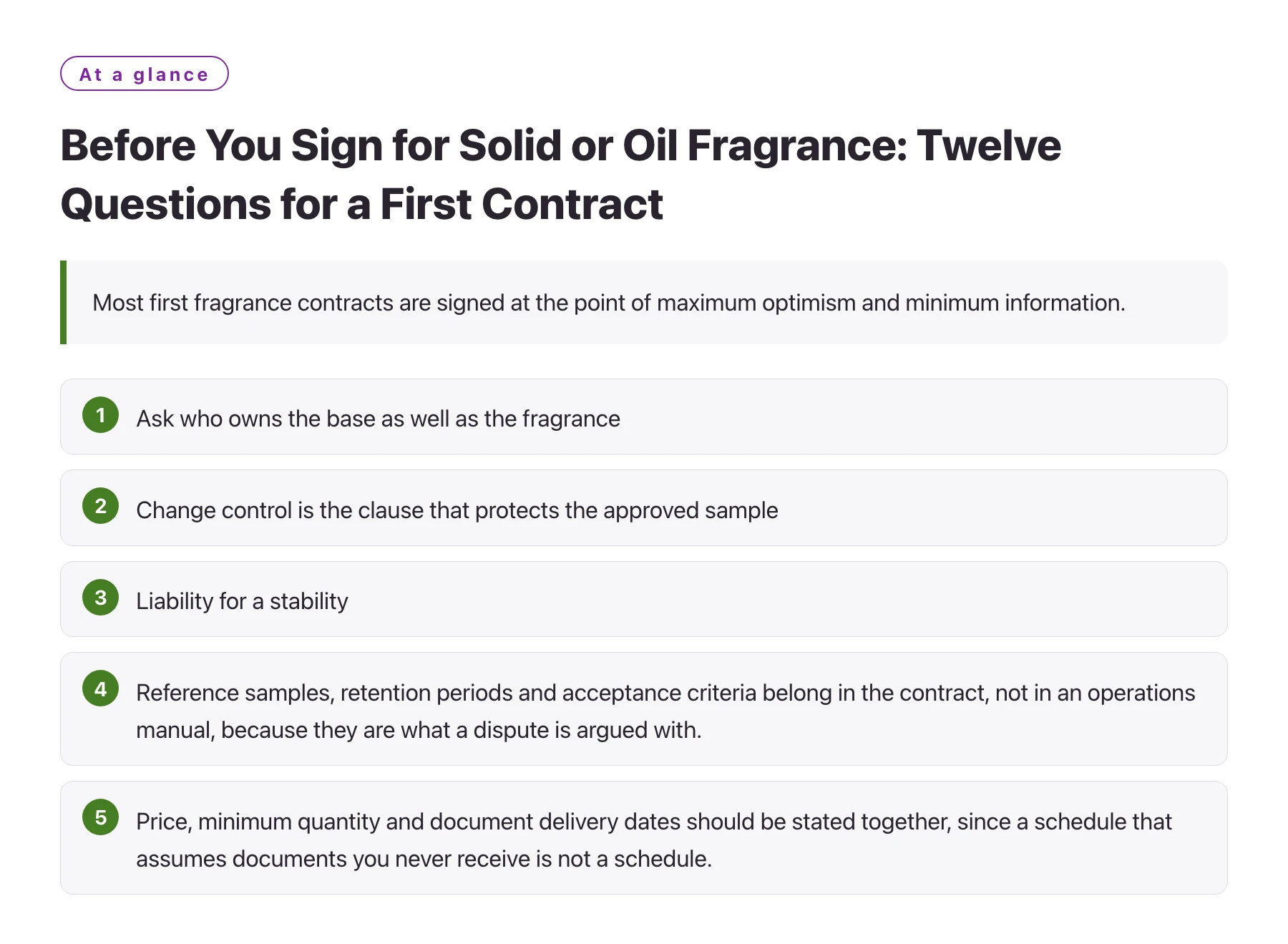
Key takeawaysAsk who owns the base as well as the fragrance, because in these formats the base is a substantial part of the product and often the part with the least paperwork. · Change control is the clause that protects the approved sample, and it should require written notice and retesting before any substitution reaches production. · Liability for a stability, heat or compatibility failure should be allocated in advance to the party that specified the test and the formula. · Reference samples, retention periods and acceptance criteria belong in the contract, not in an operations manual, because they are what a dispute is argued with. · Price, minimum quantity and document delivery dates should be stated together, since a schedule that assumes documents you never receive is not a schedule.
A first-time founder with legal help often receives a long supply agreement and no guidance on which pages matter. A founder without legal help often receives a short purchase order and assumes it covers everything. Both end up in the same place: a contract that is silent on exactly the two or three issues that a solid or oil project tends to raise.
The list below is organised as questions rather than clauses, because that is how the conversation actually runs. Each question has an answer that should then be written into the agreement in the supplier's own words.
Read it before the commercial conversation rather than after. Questions asked early are technical; the same questions asked late sound like distrust.
Why these formats need a more specific contract
In a spray project, the product is mostly solvent and the fragrance formula is the main asset. In a solid or oil project, the base is on the skin for hours and represents most of the mass. If the base was developed by the factory, the brand may hold a formula it does not own and cannot reproduce elsewhere. That is a commercial risk that a single sentence can remove or create.
The second difference is failure mode. A solid can soften or sweat, an oil can separate, and both can drift in odour during storage. These failures often appear after the goods have left the factory, which means the contract, not the inspection report, decides who pays.
The third is time. Formulas and standards change, and a product approved this year may need rechecking next year. A contract that says nothing about who rechecks and who pays for retesting leaves a recurring question unanswered [2].
Twelve questions and the clause each one produces
- Who owns the base formula?Produces an ownership and licence clause. If the factory developed the base, ask whether your brand gets exclusive use in your category and what happens if you leave.
- Who owns the fragrance formula?Produces an intellectual property clause. Ownership of a fragrance composition can be recorded through confidentiality and assignment terms, and registrable rights such as trade marks and designs sit in a different regime again [1].
- What exactly is the approved reference?Produces an acceptance clause naming the reference sample, its fill weight, its packaging and the date it was sealed.
- How long does each side keep that reference?Produces a retention clause with a number of months and a storage condition, so the comparison is meaningful when it is needed.
- What counts as an acceptable batch?Produces a specification and tolerance clause covering appearance, fill weight, odour against reference, and mechanism function.
- What happens if the bulk does not match the reference?Produces a remedy clause: rework, replacement, credit or rejection, with a defined time window for raising a claim.
- Who bears the cost of a stability or heat failure?Produces a liability clause tied to who specified the test and the formula, and to whether the agreed test was actually performed.
- What substitution is allowed without notice?Produces a change control clause. In practice the answer should be none beyond an agreed list, and any base or fragrance change should trigger a new sample approval.
- Who rechecks the formula when standards are revised?Produces a compliance maintenance clause naming the party responsible, the frequency of review and who pays for any reformulation.
- How do minimum quantities step down or up?Produces a volume ladder or a single minimum with a stated tolerance on the delivered quantity.
- How long is the quoted price valid?Produces a price validity clause, which matters because wax, carrier oils and components all move with their own markets.
- Which documents arrive before the goods leave?Produces a document delivery clause listing each paper, its issuer and its deadline, rather than promising documents generally.
The three answers that most often go wrong
Base ownership is the first. Founders ask about the fragrance and forget the base, then discover that the firmness they spent weeks tuning is a house formulation available to any client. If the base is what makes the product feel like yours, it needs the same treatment as the scent.
Change control is the second. A supplier under material pressure may substitute a wax grade or a carrier with similar properties, and the substitution is defensible in isolation while breaking the reference. The clause that prevents this is short: no substitution without written notice, and no substitution after approval without a new sample round where the substitution affects skin feel, firmness or release.
The third is the definition of acceptance. A contract that says the goods will be of good quality is not an acceptance criterion. A line that says the fill weight is within a stated tolerance, the appearance matches the sealed reference under stated light, and the odour matches a retained control is something both sides can apply without argument.
Reading the answers as a whole
The individual answers matter less than their consistency. A partner that handles custom fragrance R&D and production with one team can normally answer the base, scent and testing questions without referring to a third party, and that coherence is a reasonable proxy for how the project will run after signature custom fragrance R&D and production.
It is also worth testing the scope claim itself. A manufacturer that presents itself as a factory that turns a brief into a scent is claiming development capability, and the contract should hold that claim to milestones: a base proposal date, a first sample date, a stability start date. Positioning that cannot be scheduled is marketing rather than capability a factory that turns a brief into a scent.
The questions are equally a way to judge fit. A house such as Xuelei Perfume, which markets itself as a full-service fragrance partner, should be able to answer the twelve questions without sending each one to a different department, and the speed and precision of those answers is a fair preview of how the account will run after signature.
Finally, know who you are contracting with. The size, structure and export history of the company behind the factory determine whether the commitments are realistic for your volume, and whether a named account owner will still be there in six months the company behind the factory. None of this replaces the clauses, but it decides how much of the agreement has to be enforced rather than simply relied upon.
Send the question list to the supplier before the contract draft, and ask for answers in writing. Suppliers rarely object, and the answers make the agreement faster to negotiate because the commercial conversation has already been had on paper.
Sources
- WIPO — World Intellectual Property Organization —— The UN agency for intellectual property; resources on industrial design and patent protection relevant to product and packaging design.
- IFRA Standards Library (International Fragrance Association) —— The IFRA Standards Library lists the restrictions the fragrance industry applies to individual fragrance ingredients, based on safety assessments; it is the reference point for compliant fragrance formulation.
Frequently asked questions
Do I need a lawyer for a first fragrance order?
Not necessarily for a small order, but you do need the terms in writing. The questions above produce a short schedule that can be attached to a purchase order. For exclusive base rights, long exclusivity periods or large minimum quantities, legal review earns its cost.
The supplier says the base is theirs but I can use it forever. Is that enough?
It is enough only if it is written down with the scope defined: which products, which markets, whether the right is exclusive, and what happens if the supplier is sold or stops producing the base. An oral assurance does not survive a change of account manager.
Who should pay for retesting when a standard changes?
That is a negotiating point rather than a rule. A common arrangement is that the brand pays for reassessment of its own formula while the factory absorbs any change to the base it supplies. What matters is that the obligation is named rather than assumed.
How should liability for a heat failure be worded?
Tie it to the agreed test. If the contract specifies a heat condition, a duration and a pass criterion, and production passed that test while the market still reported a failure, the discussion becomes about the test rather than about blame. Without those three elements, liability usually defaults to a negotiation.
Should the contract mention the reference sample if we already hold one?
Yes. The physical sample matters only if the contract identifies it: which sample, sealed when, held where, by whom, and for how long. Otherwise a later disagreement about odour has no agreed baseline.